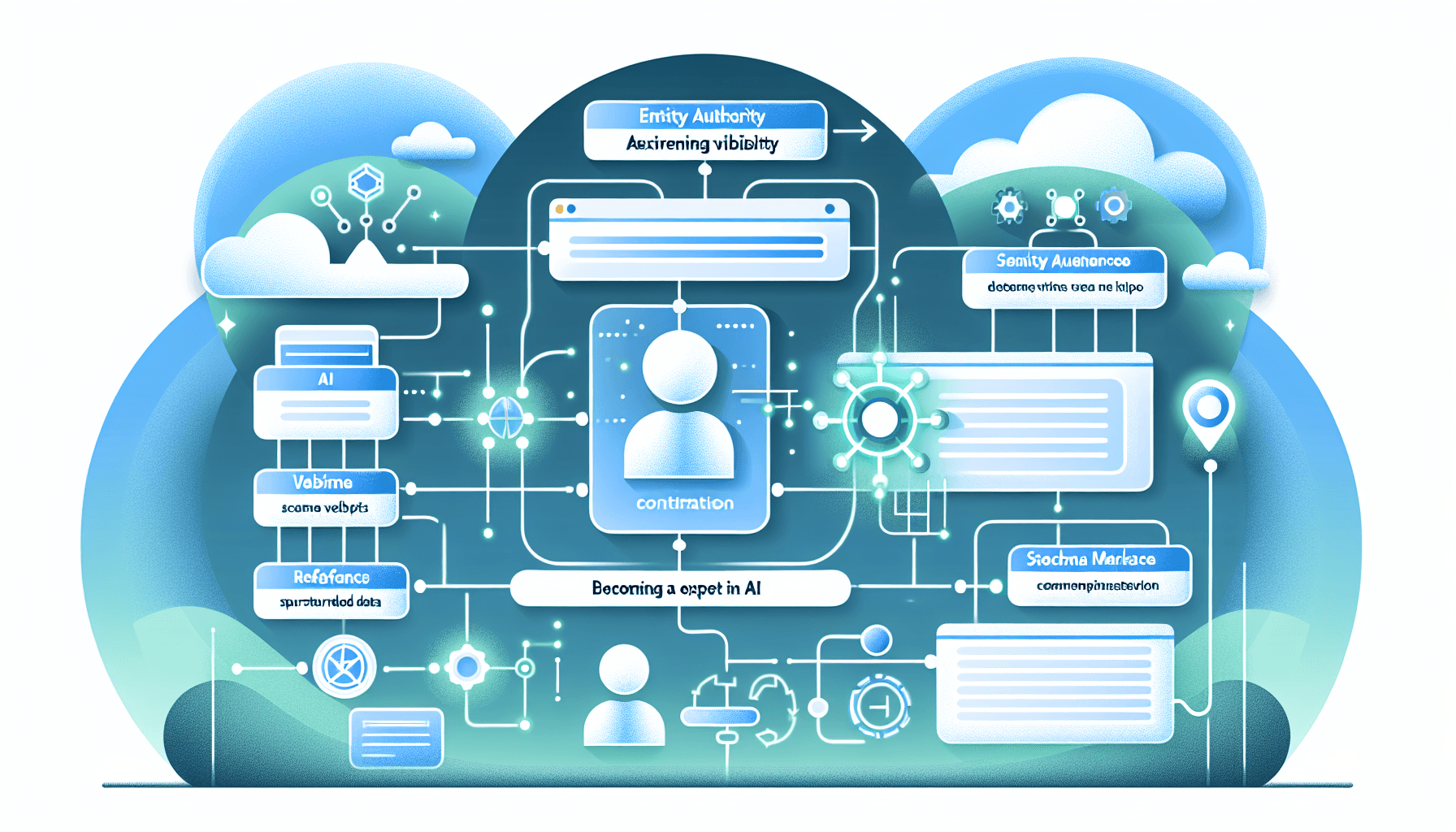
Entity authority is the level of trust AI systems place in your brand as an expert source of information. The higher this authority, the more often ChatGPT, Claude, and other AI assistants will recommend your business to users.
- 93% of users interact with AI responses weekly, making entity authority critically important
- SameAs links and structured data help local brands compete with large companies
Table of Contents
- What is entity authority and why is it important for AI?
- How do sameAs links increase AI trust in your brand?
- What content strategy works best for AI citations?
- How can local businesses compete with big brands?
- What technical settings are needed for entity authority?
- How to measure and improve entity authority?
- Frequently Asked Questions
What is entity authority and why is it important for AI?
Entity authority determines how much AI trusts your brand as a source of reliable information. Unlike traditional SEO, which focuses on search engine rankings, entity-oriented optimization works with AI's understanding of your business as a distinct entity.
AI systems evaluate brand authority through multiple signals: structured data, mentions on authoritative resources, content quality and expertise. According to EWR Digital, 93% of users interact with AI responses weekly, making presence in these responses critically important for business.
The difference between traditional SEO and entity optimization lies in approach. While SEO works with keywords and links, entity authority is built through brand identity confirmation, industry expertise, and AI trust in your information.
AI understands brands through knowledge graphs — networks of interconnected entities. When your brand has clear connections to other authoritative entities (through sameAs links, mentions, partnerships), AI better understands your context and expertise. This allows systems to confidently recommend your business in relevant situations.
Key mistakes that hinder entity authority building include lack of structured data, inconsistent brand information across platforms, and creating content without considering how AI interprets expertise. Learn more about critical mistakes in AI optimization in our detailed guide.
🔍 Want to know your GEO Score? Free 60-second check →
How do sameAs links increase AI trust in your brand?
SameAs links work as a digital passport for AI systems, confirming your brand's identity across various platforms. This schema markup creates connections between official company profiles, helping AI understand that all these accounts belong to one entity.
The principle behind sameAs schema is based on creating a network of trust. When AI sees that your website links to official profiles on Google Business, Facebook, LinkedIn, and these platforms confirm reciprocal connections, a complete brand picture forms. According to EWR Digital, brands with clear entity signals receive 4-7x more mentions in AI systems.

Most effective platforms for creating sameAs links include:
Essential platforms:
- Google Business Profile — primary trust source for AI
- Facebook Business Page — social authority
- LinkedIn Company Page — professional trust
- Official industry directories
Additional authoritative sources:
- Wikipedia (if your brand meets criteria)
- Wikidata — structured knowledge base
- Specialized industry platforms
- Local business directories
Technical implementation of sameAs in JSON-LD markup looks like this:
{ "@context": "https://schema.org", "@type": "LocalBusiness", "name": "Company Name", "sameAs": [ "https://www.facebook.com/yourcompany", "https://www.linkedin.com/company/yourcompany", "https://maps.google.com/yourlistingurl" ] }
It's important to maintain NAP (Name, Address, Phone) consistency across all platforms mentioned in sameAs. Even minor discrepancies can reduce AI trust in your brand.
Detailed guides on sameAs links and schema markup basics will help you understand technical aspects better. You can also get a free schema markup analysis on our platform.
What content strategy works best for AI citations?
AI citations require content that demonstrates expertise through specific facts, data, and sources. E-E-A-T principles (Experience, Expertise, Authoritativeness, Trustworthiness) become even more important in AI optimization context, as systems analyze not only text but also source authority.
Structuring content for AI begins with clear information hierarchy. AI better understands materials with logical structure: main thesis, supporting facts, specific examples, conclusions. Use headings, lists, tables — this helps AI extract key information for citations.
According to EWR Digital, companies with consistent web citations appear in AI engines 38% more often. This emphasizes the importance of creating content that other authoritative resources will cite and reference.
Key elements of AI-oriented content:
Factual accuracy: Every statement should have confirmation. AI verifies facts through multiple sources, so inaccuracies can harm authority.
Expert insights: Share unique experience, case studies, data from your own practice. AI values original information that can't be found in other sources.
Structured data: Use FAQ schema, Article schema, LocalBusiness schema to help AI understand context.
Source citations: Reference authoritative research, statistics, expert opinions. This increases AI trust in your content.
Creating expert content also includes working with multimodal formats. AI increasingly analyzes not only text but also images, video, audio. Multimodal content optimization becomes an important factor for comprehensive AI visibility.
Additionally, setting up llms.txt for AI visibility allows you to provide AI systems with structured information about your brand and content, improving citation accuracy.
"Maximum effect appears where AI-based tools are used not to reduce staff, but to expand capabilities." — Expert, Jay Copilot
How can local businesses compete with big brands?
Local context becomes a competitive advantage in AI recommendations, as systems increasingly consider geographic relevance of queries. AI understands that a user in New York is looking for services in their city, not general information from large international brands.
LocalBusiness schema markup gives local companies a powerful tool for increasing authority. Properly configured markup with address, hours, contacts, reviews creates a detailed profile for AI systems. According to EWR Digital, brands that appear in AI results see 2.3-4.8x growth in trust and clicks.
Strategies for local competition:
Hyperlocal expertise: Create content about your region's specifics, local features, case studies with local clients. Big brands can't compete in this niche.
Personalization: AI values authenticity. Tell stories of founders, team, unique approach to work. This creates emotional connection that's hard for corporations to replicate.
Speed of response: Local businesses can adapt faster to changes, create timely content, respond to local events and trends.
Partnerships: Collaboration with other local businesses, participation in local events, sponsorships create networks of mutual links and mentions.
Unique expert content in narrow niches often beats general materials from large companies. For example, coffee shop case with 150% growth shows how local business achieved significant results through focus on regional coffee culture expertise.
Similarly, how a barbershop reached ChatGPT top demonstrates the power of local expertise and proper AI optimization for personal service businesses.
The key to success is not trying to compete with big brands in their strengths, but creating unique value through local expertise, personal approach, and deep understanding of local audience needs.
📊 Check if ChatGPT recommends your business — free GEO audit
What technical settings are needed for entity authority?
The technical foundation of entity authority includes three key components: JSON-LD markup, AI crawler settings, and specialized files for AI systems. Proper technical implementation can significantly increase chances of your brand being cited.
JSON-LD markup for Organization and Person creates a structured profile of your business. Basic markup for local business should include:
{ "@context": "https://schema.org", "@type": "LocalBusiness", "name": "Company Name", "description": "Business description", "address": { "@type": "PostalAddress", "streetAddress": "Street, building", "addressLocality": "City", "postalCode": "ZIP", "addressCountry": "US" }, "telephone": "+1XXXXXXXXXX", "openingHours": "Mo-Fr 09:00-18:00", "sameAs": [ "https://facebook.com/yourpage", "https://linkedin.com/company/yourcompany" ] }
Optimizing robots.txt for AI crawlers becomes critically important. According to Jay Copilot, 70% of medium and large Russian companies use GenAI in 2025, increasing AI bot activity on websites.
Detailed robots.txt setup for AI includes proper directives for GPTBot, Claude-Web, Perplexity-Bot, and other AI crawlers. It's important not to block these bots completely, but manage access to different site sections.
Creating and configuring llms.txt file allows you to provide AI systems with structured information about your brand. This file is placed in the site root and contains key information for AI:
Company Name
We are a leading company in [industry] since [year].
Services
- Main service 1
- Main service 2
- Main service 3
Contact
Address: [full address] Phone: [phone number] Email: [email address]
Expertise
[Brief description of unique expertise and achievements]
Llms.txt for local business helps AI systems better understand your business specifics and properly present your brand to users.
Additional technical settings include page loading speed optimization, mobile adaptation, SSL certificates — basic factors that affect AI trust in your website.
According to Jay Copilot, 23% of organizations scale AI agent systems, making technical readiness of sites for AI interaction even more important.
If technical implementation seems challenging, you can get professional help with technical setup from specialists experienced in AI optimization.
How to measure and improve entity authority?
Measuring entity authority requires a comprehensive approach, as traditional SEO metrics don't reflect the full picture of AI visibility. Key indicators include mention frequency in AI responses, brand information accuracy, and positions in AI recommendations.
Key metrics for tracking AI citations:
AI Mention Rate: Frequency of your brand mentions in AI responses to relevant queries. Test 20-30 queries monthly in ChatGPT, Claude, Perplexity.
Brand Accuracy Score: Accuracy of information about your brand in AI responses. Check if AI correctly describes your services, address, contacts.
Recommendation Position: Your brand's position in AI recommendation lists. Top-3 positions get most user attention.
Citation Quality: Context of mentions — does AI recommend your brand as an expert, or just mention among other options.
Tools for monitoring AI response presence include specialized GEO audit platforms, manual query testing, and analyzing AI source traffic through Google Analytics.
The Mentio platform provides comprehensive GEO Score (0-100 points), evaluating site readiness for AI recommendations across 7 key parameters. Accuracy Checker identifies AI hallucinations about your brand, while Influence Engine creates personalized action plans for authority improvement.
Continuous authority improvement strategies:
Regular content audit: Update outdated information, add new cases and achievements, maintain expert content relevance.
Expanding presence: Gradually add new authoritative platforms for sameAs links, participate in industry events, guest publications.
Competitor monitoring: Analyze why AI recommends competitors, what authority signals they use.
Technical optimization: Regularly update schema markup, llms.txt file, track AI bot crawling errors.
Example of successful 420% AI visibility increase shows the importance of systematic approach to entity optimization. Comprehensive PR strategy for AI citations can also significantly increase brand authority.
It's important to understand that building entity authority is a long-term process. First results appear in 2-3 months, but stable high authority forms over 6-12 months of consistent work.
Frequently Asked Questions
What is entity authority in simple terms?
Entity authority is the level of trust AI systems place in your brand as an expert source of information. The higher the authority, the more often AI will cite your content in user responses.
How long does it take to build entity authority?
First results can be seen in 2-3 months of consistent work. Full authority forms over 6-12 months depending on niche and competition.
Can you build authority without technical knowledge?
Basic level - yes, through quality content and presence on authoritative platforms. But for maximum effect, technical optimization is needed: schema markup, llms.txt, proper settings.
Which platforms are most important for sameAs links?
Priority: Google Business Profile, official social media (Facebook, LinkedIn), industry directories, Wikipedia (if possible), Wikidata. Quality matters more than quantity.
How to check if my entity strategy is working?
Test queries in ChatGPT, Claude, Perplexity with your brand name. Track mentions, analyze structured data through Google Search Console, monitor traffic from AI sources.
Is entity authority needed for B2B business?
Yes, especially important. B2B buyers actively use AI to research suppliers. 70% of companies already use AI for business decisions, making presence critical.
What to do if AI incorrectly describes my brand?
Create detailed llms.txt with accurate information, add structured data, publish corrective content on authoritative resources. Usually AI corrects information within 1-2 months.